
How Does Solar Battery Storage Work With Solar Panels?
Solar panels generate electricity for your home during daylight hours–but what happens when they produce more electricity than your home needs?
That’s where solar battery storage comes in.
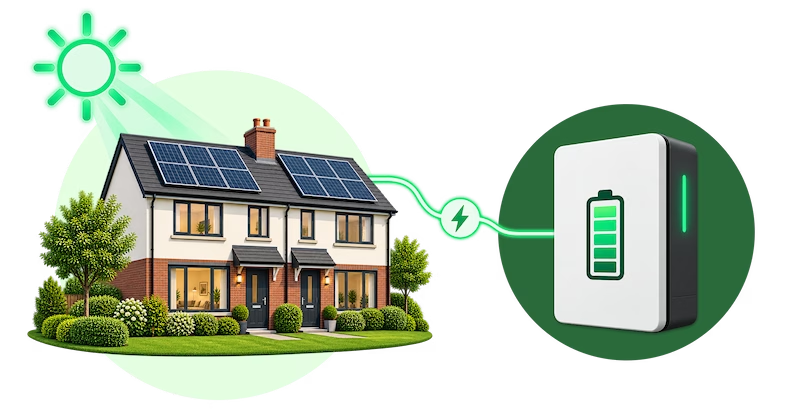
A home battery can store some of the surplus energy generated by your solar panels, allowing you to use that energy later when your panels are producing less electricity or none at all.
In this guide, we explain how solar panels and battery storage work together, what happens to surplus solar electricity, and why homeowners might choose to add a battery to their solar PV system.
How Do Solar Panels Power Your Home?
Solar photovoltaic (PV) panels convert sunlight into electricity.
During daylight hours, the electricity generated by your solar panels can be used to power appliances and electrical devices around your home. This means your property can use its own solar-generated electricity before needing to import additional electricity from the grid.
How much electricity your panels generate will vary depending on factors such as the size and orientation of the system, the weather, shading and the time of year.
Your electricity consumption also changes throughout the day.
This creates an important question: what happens when your solar panels generate more electricity than your home is using?
What Happens to Excess Solar Energy Without a Battery?
Imagine your solar panels are generating 3 kW of power at a particular moment, while your home is only using 1 kW.
Your home can use the 1 kW it needs, leaving 2 kW of surplus generation.
Without battery storage, surplus electricity that isn’t being used within the property can generally be exported to the electricity grid, subject to the configuration of your system and grid connection.
In Great Britain, eligible households may also be able to receive payments for exported renewable electricity through a Smart Export Guarantee (SEG) tariff offered by participating electricity suppliers.
Exporting electricity isn’t your only option, however.
A solar battery provides somewhere to store some of that surplus energy for later.
What Does a Solar Battery Do?
A solar battery is an energy storage system that can charge when surplus electricity is available and discharge that stored energy when your home needs it.
The basic process is:
☀️ Generate → 🏠 Use → 🔋 Store → 🌙 Use later
When your solar panels are generating electricity, your home can use that electricity directly.
If the panels are producing more than the property needs and the battery has available capacity, some of the surplus can be directed into the battery.
Later–such as during the evening, overnight or during periods of lower solar generation–the battery can discharge to help power your home.
This can increase the proportion of your solar-generated electricity that you use yourself.
How Do Solar Panels and Battery Storage Work Together?
A solar battery allows you to store some of the electricity generated by your solar panels and use it later. Here’s how it works.
1. During the day, your solar panels generate electricity
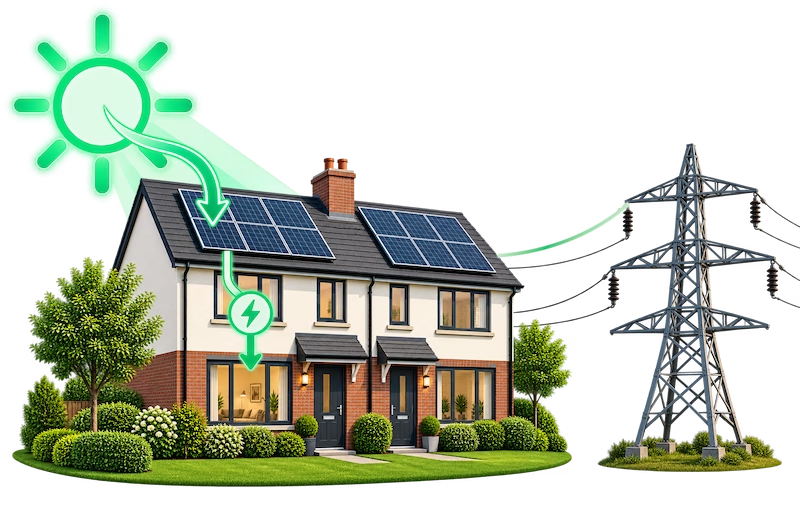
During daylight hours, your solar panels turn sunlight into electricity.
Your home uses that solar-generated electricity first, helping to reduce how much electricity you need to draw from the grid.
2. Your solar panels can generate more electricity than your home is using
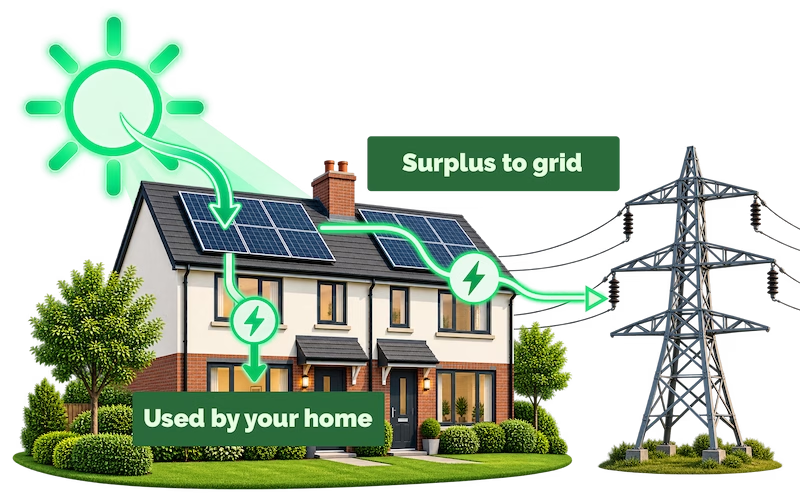
At certain times of the day, your solar panels may generate more electricity than your home needs.
Without a battery, that surplus solar electricity can be exported to the grid rather than being used by your home.
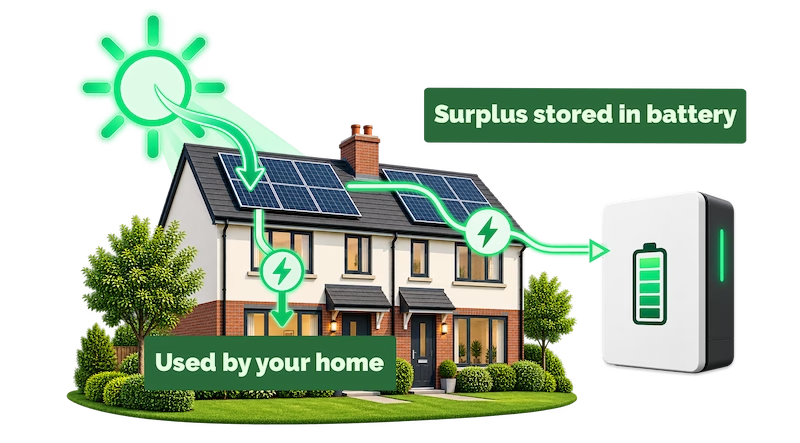
3. A battery can store some of that surplus solar energy for later
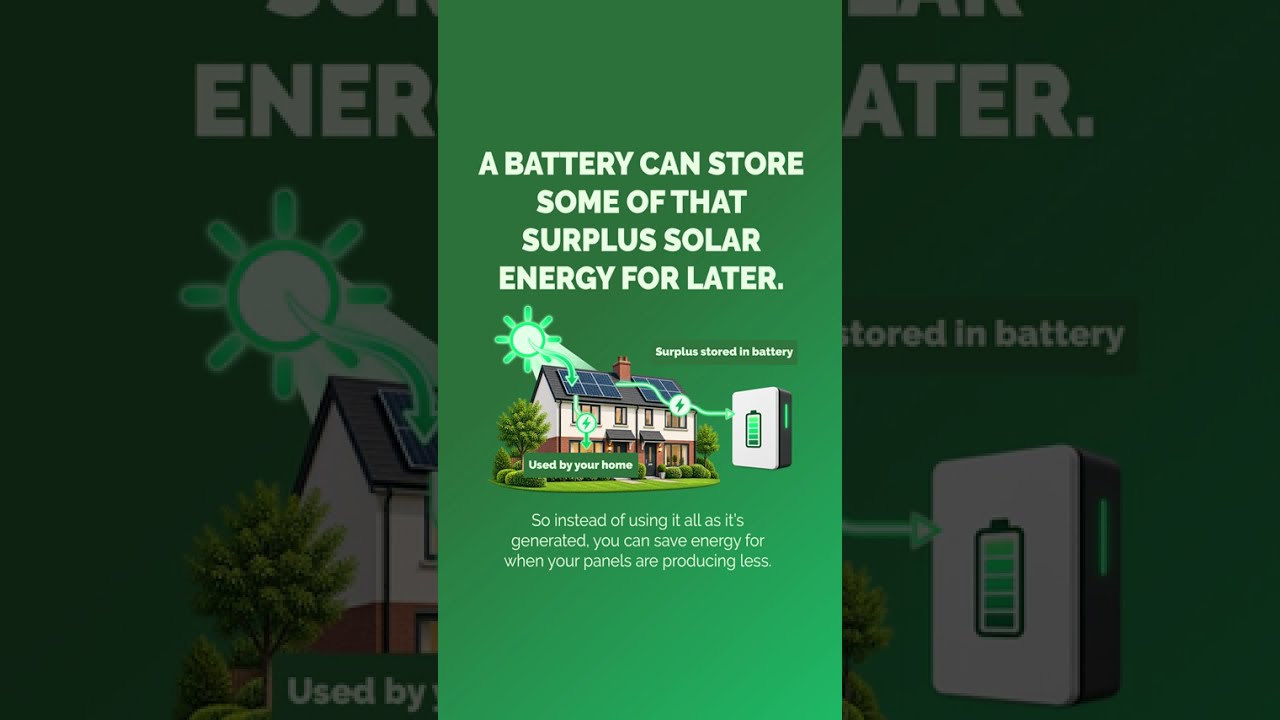
With a solar battery installed, some of the surplus electricity generated by your panels can be stored instead.
Your home still uses the solar electricity it needs first, while available surplus energy can be used to charge the battery.
This means you can save some of the electricity generated during sunnier periods for times when your solar panels are producing less.
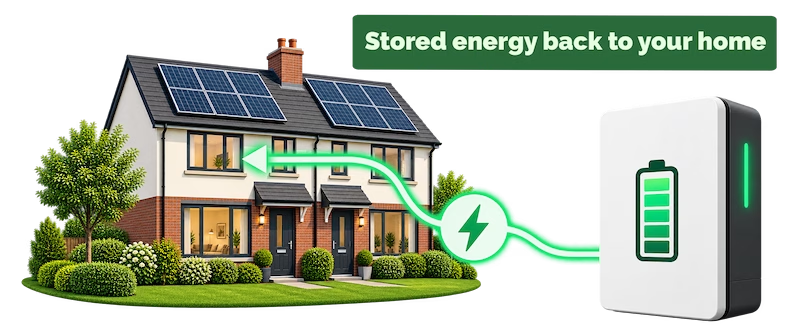
4. When the sun goes down, your battery can supply stored energy back to your home
As daylight fades, your solar panels generate less electricity and eventually stop generating for the night.
Your battery can then discharge the energy it stored earlier in the day, supplying electricity back to your home.
This helps you continue using more of your own solar-generated electricity even when your panels are no longer producing enough to meet your needs.
Once the battery’s usable stored energy has been depleted–or if your home requires more power than the battery can provide–the grid can supply the additional electricity you need.
Why Add a Battery to Solar Panels?
One of the main reasons for installing battery storage is to increase solar self-consumption.
Without a battery, the electricity your panels generate needs to be used as it is generated or, where applicable, exported.
A battery gives you another option: store some of the surplus and use it at another time.
Depending on the system, tariff and household electricity-use pattern, battery storage may help you:
- Use more of the electricity generated by your own solar panels.
- Reduce the amount of electricity you need to import from the grid at certain times.
- Shift stored electricity from one part of the day to another.
- Make greater use of surplus daytime solar generation during the evening.
- Potentially take advantage of certain time-of-use electricity tariffs with a suitably configured battery.
Some battery systems can also provide backup power during a power cut, but this functionality should not be assumed. Backup capability depends on the battery, inverter, installation and additional equipment used.
Do Solar Panels Need a Battery?
No. Solar panels can work without battery storage.
A standard grid-connected solar PV system can generate electricity that your home uses directly. Surplus electricity may then be exported to the grid.
A battery is an additional component that allows some electricity to be stored for later use.
Can You Add a Battery to Existing Solar Panels?
In many cases, yes.
Battery storage can often be added to a home that already has solar panels, although the most appropriate setup will depend on the existing solar PV system, inverter, electrical installation and the battery being considered.
What Size Solar Battery Do You Need?
There isn’t one battery size that is right for every home.
The appropriate capacity depends on factors including:
- Your household’s annual and daily electricity consumption.
- When you typically use electricity.
- The size and expected generation of your solar PV system.
- How much surplus electricity you typically produce.
- How much energy you want available during the evening or overnight.
- Whether you plan to charge the battery from the grid as well as from solar.
- Your electricity import and export tariffs.
- Battery power limits as well as storage capacity.
A bigger battery isn’t automatically better. If a battery is significantly larger than the amount of surplus energy normally available to charge it, some of its capacity may rarely be used.
Likewise, an undersized battery may fill quickly on sunny days and leave additional surplus electricity available for export.
Correct battery sizing is therefore an important part of designing an efficient solar-and-storage system.
Can a Solar Battery Power Your Home at Night?
Yes, stored electricity can be used at night, provided the battery has sufficient usable charge and can deliver the power your home requires.
For example, your panels might generate surplus electricity during a sunny afternoon and charge the battery. Once solar generation falls in the evening, the battery can begin supplying stored electricity to the home.
How long it lasts depends on the battery’s usable capacity and your electricity consumption.
High-power appliances can also affect how quickly stored energy is consumed, and batteries have maximum charge and discharge power ratings that should be considered alongside their capacity in kilowatt-hours (kWh).
Does a Solar Battery Mean You Can Go Off-Grid?
Not necessarily.
Most domestic solar-and-battery installations are still connected to the electricity grid.
The grid can provide electricity when solar generation and stored battery energy aren’t sufficient to meet demand. Depending on your installation, it can also accept surplus solar electricity when your battery is full.
What Happens When the Solar Battery Is Full?
If your home doesn’t need all of the electricity your solar panels are producing and the battery is already full, additional generation may be exported to the grid where the system and connection allow it.
This means solar, battery storage and the electricity grid can work together rather than the battery simply replacing your grid connection.
A simplified energy flow looks like this:
☀️ Solar panels → 🏠 Power your home → 🔋 Charge the battery → ⚡ Export remaining surplus
Later, when solar generation is lower:
🔋 Stored electricity → 🏠 Power your home → ⚡ Grid supplies any additional electricity required
Frequently Asked Questions About Solar Batteries
Do solar panels work without a battery?
Yes. Solar panels do not require a battery to generate electricity. A grid-connected solar PV system can supply electricity directly to your home, with eligible surplus generation potentially exported to the grid.
Does a solar battery charge every day?
Not necessarily. How much a battery charges depends on factors including solar generation, household consumption, battery settings and whether the system is configured to charge from the electricity grid.
Can a battery be installed after solar panels?
Often, yes. Many existing solar PV systems can have battery storage added later, although compatibility and the most appropriate system design should be assessed first.
Does a solar battery work in winter?
Yes, but there may be less surplus solar electricity available to charge it because UK solar PV systems generally generate less electricity during the shorter winter days. Some systems can also charge from the grid, depending on their configuration.
What happens to solar electricity when the battery is full?
Once the battery reaches its permitted charge level, surplus electricity that your home isn’t using may be exported to the grid, subject to the system configuration and connection arrangements.
Can a solar battery run the whole house?
Potentially, but this depends on the battery’s usable capacity, maximum power output, the home’s electricity demand and how the system is configured. Capacity (kWh) and maximum power (kW) are both important.

Gary is the Operations Manager at Fairway Energy and a specialist in renewable energy and technology, with over 15 years’ experience. He has in-depth expertise in energy-efficient measures for residential properties and UK government-backed grant schemes and funding.